
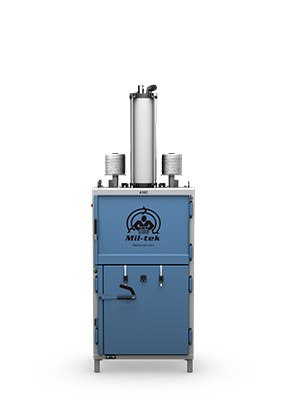
A102 Small baler
- Very small footprint, only 0.45 m²
- 6–10 sec. pressing cycle
- Bale 40 kg cardboard / 100 kg plastic
- Optimal working height
the test page 8
Not sure which baler fits? Try one on site, or let us assess your waste streams first.
Try a baler at your own site and see the difference in your daily routine before you decide.
A Mil-tek adviser assesses your waste streams and recommends the right machine for your site.
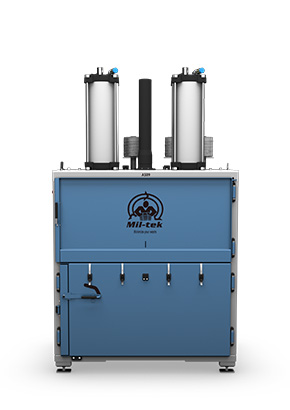
Produces bales from 40–300 kg.
Pneumatic balers run on compressed air. They fit easily into environments like cafés, warehouses and production lines across all industries.
Designed for recyclables such as cardboard and soft plastics, they are best suited for lighter, flexible materials.
A pneumatic baler compacts waste very efficiently. The fastest models feature a pressing cycle of only 6 seconds.
Operating without hydraulic oil eliminates leak risks. The simple air-powered system ensures reliable performance with straightforward maintenance.
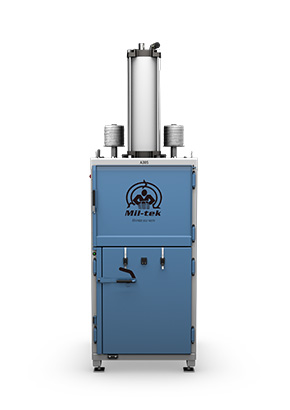
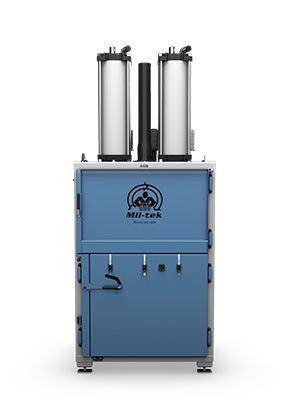
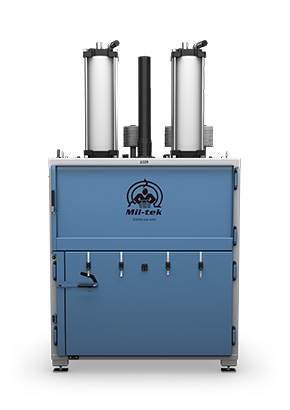
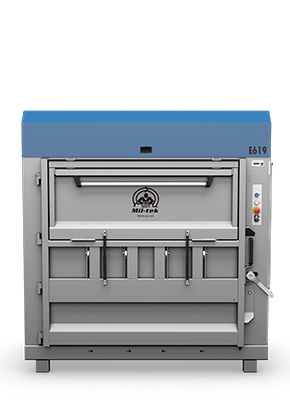
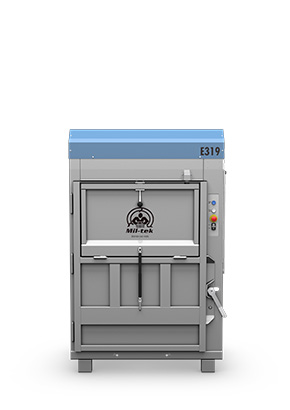
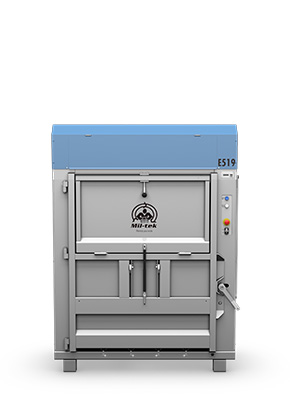
Produces bales from 50–400 kg.
Electric balers operate on a standard power supply and require no compressed air. They are easy to install in retail stores, offices and warehouses.
They compact cardboard and soft plastics into dense bales and can also handle PET bottles, offering stronger compaction than pneumatic models.
With higher bale weights, electric balers provide improved volume reduction and are suited for businesses with steady or increasing waste quantities.
With no hydraulic oil involved, there is no risk of spills. They combine clean operation with reliable pressing force in a self-contained solution.
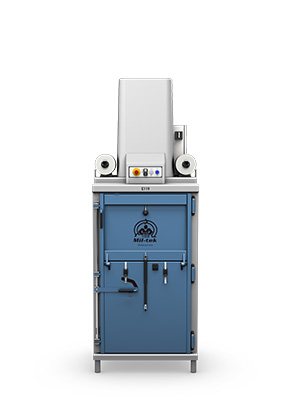
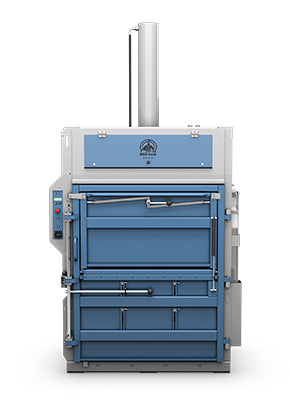
Produces bales from 250–520 kg.
Hydraulic balers are designed for companies generating large and continuous amounts of recyclable waste, delivering significantly greater pressing force.
They handle large volumes of cardboard as well as PET bottles and rigid plastics, making them suitable for demanding waste streams.
By producing dense, heavy bales, hydraulic balers reduce storage needs and collection frequency, improving transport efficiency.
Built for intensive, long-term operation, hydraulic balers provide maximum compaction performance for industrial environments.
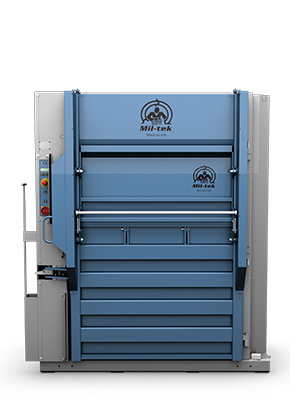
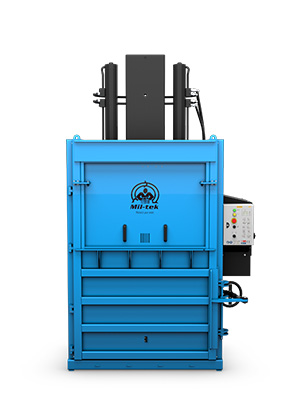
A powerful solution to compact large volumes of waste into compact, stackable bales.
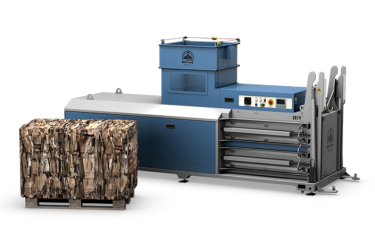
| A102 | A305 | A509 | E119 | E319 | E619 | H600 | H501 | 50SD | |
|---|---|---|---|---|---|---|---|---|---|
| Cardboard bale | < 40 kg | < 90 kg | < 210 kg | < 50 kg | < 80 kg | < 300 kg | 340-450 kg | 350 - 400 kg | < 500 kg |
| Plastic bale | < 100 kg | < 165 kg | < 280 kg | < 80 kg | < 100 kg | < 400 kg | 340-500 kg | 350 - 450 kg | < 520 kg |
| Pressing cycle | 5-10 sec | 8-20 sec. | 12-25 sec. | 43 sec | 63 sec. | 65 sec. | 36 sec. | 40 sec. | 55 sec. |
| Degree of compaction | 85-90% | 85-90% | 85-90% | 85-90% | 85-90% | 85-90% | 85-90% | 85-90% | 85-90% |
| Bale size H x W x D (mm) | 710-830 x 655 x 450 | 710-830 x 655 x 850 | 710-830 x 1250 x 835 | 710-830 x 655 x 545 | 700-800 x 900 x 500 | 800-900 x 1500 x 800 | 800 x 1200 x 1100 | 800 x 1200 x 800 | 1120/1170 x 1270 x 770 |
| Door opening H x W x D (mm) | 505 x 655 x 415 | 570 x 655 x 815 | 570 x 1250 x 800 | 480 x 630 x 500 | 600 x 900 x 500 | 550 x 1500 x 800 | 550 x 1160 x 780 | 670 x 1200 x 780 | 610 x 1140 x 770 |
| Machine size H x W x D (mm) | 2192 x 831 x 541 | 2380 x 829 x 1034 | 2380 x 1420 x 1040 | 2260 x 800 x 720 | 1855 x 1165 x 810 | 2070 x 1915 x 990 | 2170 x 1890 x 1400 | 3100 x 1600 x 1300 | 3160 x 1885 x 1105 |
| Noise level | < 70 db (A) | < 70 db (A) | < 70 db (A) | < 70 db (A) | <60 dB (A) | <65 dB(A) | < 70 db (A) | < 70 db (A) | < 70 db (A) |
| Pressure | 2500 kg at 8 bar | 4000 kg at 8 bar | 8000 kg, at 8 bar | Up to 2,5 tonnes | 15.000 kg | 25.000 kg | <60 tons | <50 tons | 50 tons |
| Approvals | CE, EN16500, UKCA | CE, EN16500, UKCA | CE, EN16500, UKCA | CE, EN16500 | CE, EN16500, UKCA | CE, EN16500, UKCA | CE, GS & UKCA | CE, GS & UKCA | CE, EN16500, UKCA |
| Power supply | 1 x 230V/50Hz / 10 Amp | 3 X 400V / 16 Amp | 3 X 400V / 16 Amp | 7,5 kW - 3x400V - 25 Amp |
1. Load – Put loose boxes and cardboard straight into the chamber – no flattening needed.
2. Compact – Close the door and press start. Repeat until the chamber is full.
3. Tie off and eject – Tie the bale, eject it and store it until collection by your recycler.
Read the full guide: How does a cardboard baler work?

60% savings on waste pickups and the investment paid back within a year. By compacting cardboard and big bags.
Learn more
Internal forklift transport reduced by 75% by implementing a Lean waste handling solution.
Learn more
Internal transport reduced by 60%, improved efficiency, and achieved zero waste to landfill thanks to a baler.
Learn moreAt Mil-tek, we offer flexible solutions for acquiring your cardboard baler. Whether you’re considering cardboard baler hire or outright purchase, we ensure a seamless experience tailored to your business needs.
A cardboard baler compacts loose cardboard boxes and pieces into bales, using pneumatic, hydraulic or electric pressure.
You simply load the cardboard in the chamber, close the door, press the start button, and the machine starts compacting. Once full, the bale is tied off and removed. Read more: How does a cardboard baler work
Common types of cardboard balers include vertical cardboard balers, horizontal cardboard balers, and twin-chamber balers.
Small businesses typically choose vertical balers, while high-volume operations benefit from horizontal or mill-size balers.
The right machine depends on things like waste volume, available space, and required bale weight.
Bale size varies by machine:
Heavier bales are ideal for selling directly to recyclers, who often prefer mill-size weights.
A baler reduces waste collections, lowers disposal costs, and frees up valuable floor space.
It also cuts labour time spent flattening cardboard and can generate revenue if you sell baled cardboard to recyclers.
Cleaner, safer, and more sustainable operations are common benefits.
Cardboard balers are primarily designed for cardboard and paper, but many models can also compact soft plastics such as shrink wrap or plastic film. Some higher-pressure models are even capable of compacting PET bottles if specified for that purpose.
For best recycling quality, materials should always be clean, dry, and properly sorted. Mixing different material types is not recommended.
Mil-tek balers and compactors are engineered with safety at their core. Designed to be simple, easy and safe to operate, they feature built-in fail-safe mechanisms and are rigorously tested to meet EN16500 safety standards.
For most businesses that handle cardboard every day, yes. A baler cuts the number of waste collections, frees up floor space and saves the time spent flattening boxes. How much it saves depends on your cardboard volume and current collection costs – a free site survey gives you the answer for your site.
The cost depends on the model and power source, the bale size you need, and whether you hire, buy new or buy refurbished. Tell us about your waste volumes and we will send you a quote.
Operators should receive basic training, follow safety signage, and never reach into the chamber. Routine checks include monitoring hydraulic oil, cleaning the machine, and inspecting wear parts. Servicing is minimal but should be carried out regularly to keep the baler running smoothly.
For many businesses the result of the waste legislation is more bins, more collections, less space, higher costs. But with a cardboard baler you can avoid yet another bin. Compact the cardboard on site and transform your waste management process.
Cardboard rebate values in the UK fluctuate monthly based on market demand. As a guide:
Read more: Can you get money for cardboard?
In most cases, no planning permission is required to install a cardboard baler on your premises, as balers are classified as standard industrial equipment. However, UK businesses should ensure:
Looking for a cardboard compactor, cardboard crusher or cardboard compressor? For cardboard, the machine you need is a cardboard baler. It compacts loose boxes into tight bales that are collected for recycling – a compactor is built for general waste. Here’s how to tell them apart: